Nine Hole Whistles
(:title-en Nine-Hole Whistles:)
(:title-de Neun-Loch Whistles:)
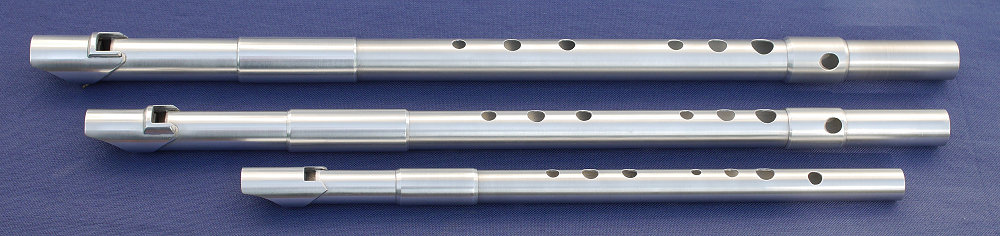
F, G and C nine-hole whistles
A new kind of whistle with a strong tone allowing chromatic playing as possible on recorders, but with a minimum of cross-fingering and half-holing, and with strong and well-tuned bottom notes. The nine-hole whistle has three finger holes plus a thumb hole for the left hand and four finger holes plus a thumb hole for the right hand.
F, G und C Neun-Loch Whistles
Eine neue Art von Whistle mit kräftigem Ton, die chromatisches Spielen erlaubt, wie es mit Blockflöten möglich ist, aber mit minimalem Einsatz von Gabel- und Halblochgriffen, und mit kräftigen und gut gestimmten unteren Tönen. Die Neun-Loch-Whistle hat drei Fingerlöcher sowie Daumenloch für die linke Hand und vier Fingerlöcher sowie Daumenloch für die rechte Hand.
- Alto-F nine-hole whistle - 210 GBP
- made out of thin-walled aluminium tubing with 20mm bore, tuning barrel and foot joint.
- Alto-G nine-hole whistle - 190 GBP
- made out of thin-walled aluminium tubing with 18mm bore, tuning barrel and foot joint.
- Soprano-C nine-hole whistle - 145 GBP
- made out of thin-walled aluminium tubing with 15mm bore, tuning barrel.
- Alto-F Neun-Loch Whistle - 210 GBP
- aus leichtem Alurohr mit 20mm Bohrung, stimmbar, mit Drehfuß.
- Alto-G Neun-Loch Whistle - 190 GBP
- aus leichtem Alurohr mit 18mm Bohrung, stimmbar, mit Drehfuß.
- Soprano-C Neun-Loch Whistle - 145 GBP
- aus leichtem Alurohr mit ca. 15mm Bohrung, stimmbar.
Description:
Below for convenience the note names for the Soprano C model are used. For the Alto F and G models you may want to transpose these names. See also the fingering chart below.
In many ways one can play the nine-hole whistle like a recorder, with some important differences:
- The added right thumb hole (RT) adds a strong and in-tune F# (left hand holes and right thumb hole closed). Closing the right hand first finger (R1) as well produces a strong an in-tune F. So no forked fingerings are used for these two important notes, which are often problematic in tone and intonation on recorders. With RT and the other right finger holes open a G is played (all left finger holes closed).
- In the second octave the fingerings for F and F# are the same, no forked fingerings are used.
- The cylindrical bore and wide tone holes allow for strong bottom notes (C, D, E, F, F#). The second octave C and D can also be produced by overblowing, as whistle players appreciate, so a player has alternatives for these notes (especially the second octave D with both thumbs and six fingers down can prove very useful).
- The left hand notes (A, B, C, C#, D) are fingered the same as on recorders, and the left thumb hole (LT) works the same. It can also be "pinched" as on a recorder for the second octave notes, and thereby the second octave notes can be played a bit softer than it is possible to do on standard whistles. In contrast to recorders, this pinching (half-holing) of LT is not needed for the lower second octave.
- For G#, Bb and C forked fingering is used as for recorders.
- A strong Eb/D# can be played by half-holing the large R3 hole.
- The Alto F and G models both have a foot joint with a raised bottom hole (R4), which can be rotated to suit the player's grip. The Alto F model needs large hands to cover the bottom holes with the finger pads, for smaller hand sizes they can be covered using piper's grip.
Beschreibung:
Nachfolgend werden die Notenbezeichnungen für das Soprano C Modell verwendet. Für die Alto F und G Modelle sollten diese transponiert werden. Siehe auch die Grifftabelle weiter unten.
In vieler Weise spielt sich die Neun-Loch Whistle wie eine Blockflöte, mit einigen bedeutenden Unterschieden:
- Das zusätzliche rechte Daumenloch produziert ein kräftiges gut gestimmtes Fis (mit allen Löchern der linken Hand und das rechte Daumenloch geschlossen). Wenn zusätzlich das rechte erste Fingerloch (R1) geschlossen wird, ertönt ein kräftiges und gut gestimmtes F. Es werden keine Gabelgriffe für diese beiden wichtigen Töne benutzt, die ja oft auf Blockflöten problematisch sind, in ihrem Ton wie auch der Stimmung. Mit allen Löchern der linken Hand geschlossen und RT und die anderen Löcher der rechten Hand offen wird ein G gespielt.
- In der zweiten Oktave wird Fis und F genau so, ohne Gabelgriffe, gegriffen.
- Die zylindrische Bohrung und die grossen Tonlöcher ermöglichen kräftige tiefe Töne (C, D, E, F, Fis). Das C und D in der zweiten Oktave kann auch gespielt werden, indem der erste Oktavton überblasen wird. Whistlespieler werden das zu schätzen wissen. Dadurch bieten sich Alternativen für diese Töne (besonders das überblasene Zweitoktav-D kann sehr nützlich sein).
- Die Töne der linken Hand ((A, H, C, Cis, D) werden genau so gegriffen wie auf Blockflöten, und das linke Daumenloch (LT) hat die gleiche Funktion. Es kann auch wie bei Blockflöten "gekniffen" werden, und zweite Oktavtöne können dadurch etwas sanfter gespielt werden, als es auf normalen Whistles möglich ist. Jedoch ist im Gegensatz zu Blockflöten dieses Kneifen des Daumenloches nicht unbedingt nötig für die unteren Töne der zweiten Oktave.
- Für Gis, B (Bb international) und C werden die für Blockflöten üblichen Gabelgriffe benutzt.
- Ein kräftiges Es/Dis kann durch einen Halblochgriff von R3 gespielt werden.
- Die Alto F und G Modelle haben beide einen Fuß mit einem erhöhtem R4 Loch, den man drehen kann. Dadurch kann man die Lochposition an die eigene Hand anpassen.
Some questions answered:
- Is it easy to adapt using the right thumb?
- In my experience it is no more difficult than training the left thumb on a recorder, and even easier than learning forked fingering for F# and F on a baroque-style recorder. For instance to play a C major scale one lifts one right hand finger after the other, and when lifting R1 one also opens the right thumb hole, so R1 and RT move together. And when playing a D major scale starting with R4 open first R3 is opened for E, then R2 and R1 are opened together for F#, then RT is opened for G, etc. the higher notes as on a recorder. So one learns to move two fingers at the same time for the single tone step.
- What about holding the whistle?
- When playing the right hand notes the right thumb is on the whistle covering its hole and giving the usual support. When playing left hand notes the right thumb need to support the instrument only for the C#, but it could be used for support also when playing B and C. It needs to be off its hole when playing G and A, and on plus some other right fingers for forked fingering for G# and Bb. When using the right thumb, playing F# and G, I like to hold down R4 for additional steadiness, or closing and opening RT and R3 both together, which has the added effect of flattening F# slightly, in fact producing a just intoned F#, which I prefer when playing in the key of D.
Antwort auf einige Fragen:
- Wie schwer ist es den rechten Daumen zu benutzen?
- Nach meiner Erfahrung es ist nicht schwieriger als den linken Daumen für das Blockflötenspiel zu trainieren, und leichter als die F und Fis Gabelgriffe für Barockblockföten zu lernen. Zum Beispiel wird für C-Dur ein Finger nach dem anderen gehoben, und wenn R1 gehoben wird, hebt man gleichzeitig auch den rechten Daumen (RT) ab. Also R1 und RT werden immer gleichzeitig benutzt. Und wenn man in D-Dur spielt, vom Grundton D (mit R4 gehoben) wird erst R3 gehoben (für E), dann R1 und R2 gleichzeitig (für Fis), dann RT (für G). Also man benutzt R1 und R2 gleichzeitig für den E-Fis Tonschritt.
- Wie hält man diese Whistle?
- Wenn die unteren Rechte-Hand Töne gespielt werden, ist der rechte Daumen auf dem Loch und gibt die übliche Stütze. Wenn die oberen Linke-Hand Töne gespielt werden, braucht man die rechte Daumenstütze eigentlich nur für H und C. Der rechte Daumen muss gehoben sein für G und A, und auf dem Loch, sowie ein paar andere rechte Finger auf den Löchern, für die Gabelgriffe für Gis und B (Bb international). Wenn ich Fis und G spiele, und der rechte Daumen abgehoben wird, mag ich R4 auf dem Loch sitzen fühlen, für eine zusätliche Stützung. Oder, noch besser, ich öffne und schließe Rt und R3 zusammen. Damit wird das Fis etwas tiefer, und ist nun rein gestimmt, was mir besser gefällt, wenn ich in D spiele.
Fingering Chart for (select key)
Grifftabelle für (wähle Tonart)
low register notes:unteres Register
| C | ● ● ● ● ● ● ● ● ● |
| C# | ● ● ● ● ● ● ● ● ◘ |
| D | ● ● ● ● ● ● ● ● ○ |
| Eb | ● ● ● ● ● ● ● ◘ ○ |
| E | ● ● ● ● ● ● ● ○ ○ |
| F | ● ● ● ● ● ● ○ ○ ○ |
| F# | ● ● ● ● ● ○ ○ ○ ○ |
| G | ● ● ● ● ○ ○ ○ ○ ○ |
| G# | ● ● ● ○ ● ● ● ● ○ |
| A | ● ● ● ○ ○ ○ ○ ○ ○ |
| Bb | ● ● ○ ● ● ● ● ● ○ |
| B | ● ● ○ ○ ○ ○ ○ ○ ○ |
| C | ● ○ ● ○ ○ ○ ○ ○ ○ |
| C# | ○ ● ● ○ ○ ○ ○ ○ ○ |
| D | ○ ○ ● ○ ○ ○ ○ ○ ○ |
high register notes:oberes Register (überblasen)
| C | ● ● ● ● ● ● ● ● ● | ||
| C# | ● ● ● ● ● ● ● ● ◘ | ||
| D | ● ● ● ● ● ● ● ● ○ | ||
| Eb | ● ● ● ● ● ● ● ◘ ○ | ||
| E | ◘ ● ● ● ● ● ● ○ ○ | ||
| F | ◘ ● ● ● ● ● ○ ○ ○ | ||
| F# | ◘ ● ● ● ● ○ ○ ○ ○ | or F# | ◘ ● ● ● ● ○ ○ ● ○ |
| G | ◘ ● ● ● ○ ○ ○ ○ ○ | ||
| G# | ◘ ● ● ○ ● ● ○ ○ ○ | ||
| A | ◘ ● ● ○ ○ ○ ○ ○ ○ | ||
| Bb | ◘ ● ○ ● ○ ○ ○ ○ ○ | ||
| B | ◘ ● ○ ○ ○ ○ ○ ○ ○ | ||
| C | ◘ ● ○ ● ● ● ○ ○ ○ | or C | ● ○ ● ● ● ● ● ○ ○ |
| C# | ◘ ● ○ ● ● ● ○ ● ● | or C# | ● ● ● ● ● ● ○ ● ● |
| D | ◘ ● ○ ● ● ○ ● ○ ○ | or D | ● ○ ● ● ● ○ ● ○ ○ |
See also: C Recorder Whistle
Siehe auch: C Blockflöten-Whistle
< C-Recorder-Whistle | Up | Multi-Modal-Whistles >