Extended Just Baglama Tuning
Repositioning the baglama frets for an extended just intonation
https://en.wikipedia.org/wiki/List_of_pitch_intervals
Fret distances from nut for extended just intonation
Interval ratios are based on Indian just intoned 22 note scale, with 5 notes left out.
Multiply string length by Distance Factor to give distance of fret from nut (example in last column for string length 765mm).
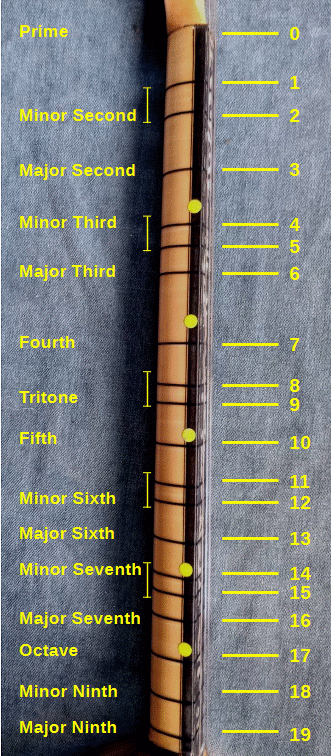
Neck side view. Yellow lines are not to scale!
| # | Note | Intv | Freq. Ratio | Cents | Fret # | Dist. Factor | from Nut |
|---|---|---|---|---|---|---|---|
| 0 | C | I | 1:1 | 0 | 0 | 0 | 0mm |
| 1 | D♭↓ | IIb- | 256:243 | 90 | 1 | 13/256 | 38.9mm |
| 2 | D♭ | IIb | 16:15 | 112 | 2 | 1/16 | 47.8mm |
| D↓ | II- | 10:9 | 182 | 1/10 | 76.5mm | ||
| 3 | D | II | 9:8 | 204 | 3 | 1/9 | 85mm |
| 4 | E♭↓ | IIIb- | 32:27 | 294 | 4 | 5/32 | 119.5mm |
| 5 | E♭ | IIIb | 6:5 | 316 | 5 | 1/6 | 127.5mm |
| 6 | E | III | 5:4 | 386 | 6 | 1/5 | 153mm |
| E↑ | III+ | 81:64 | 408 | 17/81 | 160.5mm | ||
| 7 | F | IV | 4:3 | 498 | 7 | 1/4 | 191.3mm |
| F↑ | IV+ | 27:20 | 520 | 7/27 | 198.3mm | ||
| 8 | F# | IV# | 45:32 | 590 | 8 | 13/45 | 221mm |
| 9 | F♯↑ | IV#+ | 64:45 | 610 | 9 | 19/64 | 227mm |
| 10 | G | V | 3:2 | 702 | 10 | 1/3 | 255mm |
| 11 | A♭↓ | VIb- | 128:81 | 792 | 11 | 47/128 | 281mm |
| 12 | A♭ | VIb | 8:5 | 814 | 12 | 3/8 | 287mm |
| A | VI | 5:3 | 884 | 2/5 | 306mm | ||
| 13 | A↑ | VI | 27:16 | 906 | 13 | 11/27 | 311.7mm |
| 14 | B♭↓ | VIIb | 16:9 | 996 | 14 | 7/16 | 334.7mm |
| 15 | B♭ | VIIb | 9:5 | 1018 | 15 | 4/9 | 340mm |
| 16 | B | VII | 15:8 | 1088 | 16 | 7/15 | 357mm |
| B↑ | VII+ | 243:128 | 1110 | 115/243 | 362mm | ||
| 17 | C | VIII | 2:1 | 1200 | 17 | 1/2 | 382.5mm |
| 18 | D♭ | IXb | 32:15 | 1312 | 18 | 17/32 | 406.4mm |
| 19 | D | IX | 9:4 | 1404 | 19 | 5/9 | 425mm |
Notes to this table:
The Distance Factor equals 1-1/Frequency Ratio: for example the Fifth V has a frequency ratio of 3:2 over the Tonic I (the freuency is 1.5 times that of the tonic note). The vibrating string for the V has 2/3 length, which leaves 1/3 length of the string to the nut.
This table is based on the Indian just intonation scale with 22 shrutis (notes) per octave, (based on 5-limit just intonation).
The upper part of the octave from G to C mirrors the lower part from C to F. The F# notes mirror the Db notes.
The "Note" column is only for relative note reference, the baglama does not need to be tuned to "C". I use a tuning of C G C, strings of first course and third course are tuned to "C", and the middle second course strings are tunes to "G". This helped to set up the fret positions, first by measuring, then by ear, positions might need small adjustments!
To play this just intoned baglama with the middle course tunes to "F" instead of "G" is a nice alternative for a different musical character.
Traditional Turkish baglama scale
The musical scale of the bağlama differs from that of many western instruments – such as the guitar – in that it features ratios that are close to quarter tones. The traditional ratios for bağlama frets are listed in the table below. Most are very close to 24-TET notes and instrument makers now often set frets on the bağlama with the aid of fret calculators and tuners based on the 24-tone equal temperament.
(:csv #data2:)